At a glance
- NICE (2019) guidance says high calcium "often causes few or no symptoms"1.
- Most people with an overactive parathyroid find out by chance, from a blood test done for another reason2.
- The NHS lists signs such as thirst, peeing a lot, constipation, tiredness, aches and pains, and low mood3.
- If you have symptoms, NICE recommends a blood test for albumin-adjusted calcium1.
This is for informational purposes only. It is not to be taken as medical advice.
Parathyroid symptoms can be vague and could be caused by lots of other things, and many people have few or none. This guide explains the signs, who is most often affected and when to get help. It is about overactive glands (hyperparathyroidism), not underactive glands (hypoparathyroidism), which cause different symptoms.
What are the symptoms of parathyroid problems?
NICE (2019) guidance says most symptoms of an overactive parathyroid come from too much calcium in the blood1. Signs include tiredness, aches, thirst, peeing a lot and constipation, but some people have none1,3. A blood test is how you find out.
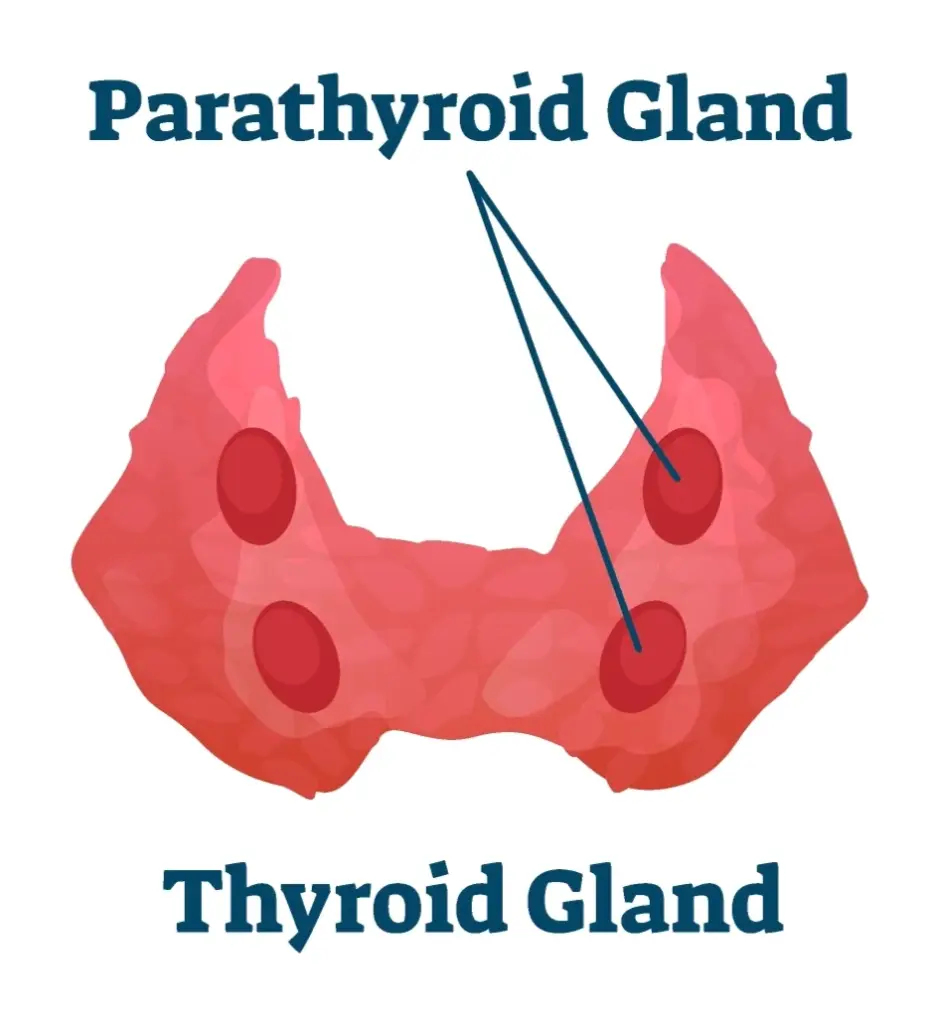
Most people have four small parathyroid glands, which sit in the neck behind the thyroid4. They control your calcium. When one or more of the glands becomes overactive, calcium rises. Doctors call this primary hyperparathyroidism.
The NHS list of symptoms is3:
- feeling very tired
- aches and pains
- muscle weakness
- feeling or being sick, and loss of appetite
- constipation and tummy pain
- being very thirsty and peeing a lot
- low mood or depression
NICE also mentions memory problems1. In my experience, some people also notice they feel irritable or find it hard to concentrate, sometimes described as "brain fog".
Can you have a parathyroid problem with no symptoms?
Yes. NICE says high calcium "often causes few or no symptoms"1. Most people are diagnosed when high calcium turns up by chance, on a routine blood test or a test for something else2. So, feeling well does not rule it out.
If you have any of these signs, ask your GP about a calcium test.
Are parathyroid symptoms different in women?
The main difference for women seems to be how often it happens. NICE (2019) says women are twice as likely as men to develop primary hyperparathyroidism, and in UK women it is most often diagnosed between 50 and 60 years of age1.
In my view, testing patterns may explain part of this gap. Because the condition is more common from age 50-60, it coincides with the menopause age bracket. People feel unwell and assume it is menopause. When their symptoms don’t improve, they visit a doctor who eventually does a calcium test and starts the ball rolling.
It is likely that this scenario contributes to a higher detection rate in women than men for a condition that sometimes produces few symptoms. Symptoms are similar regardless of age or gender. However, how much they improve after surgery can vary, because other causes of mild “generic” symptoms (such as urinary frequency, bowel habit and tiredness) are more common in some age groups and genders than others.
Can parathyroid problems make you tired, anxious or low?
They can, but the link is not clear-cut. NICE recognises long-term, vague symptoms such as tiredness, mild confusion, anxiety, low mood and poor sleep1. NICE says GPs should consider a calcium test but notes their link with primary hyperparathyroidism "is uncertain"1.
Some studies link hyperparathyroidism with mood and thinking problems but cannot prove it is the cause and some trials have not shown that surgery consistently helps these symptoms7.
In my view, this uncertainty arises because these common symptoms often have more than one cause. Primary hyperparathyroidism is one contributing factor, but it is not necessarily the only one. Treating the parathyroid problem removes the part of the symptoms caused by the parathyroids, but it will not resolve other causes, many of which may be lifestyle related.
This explains the researchers’ findings, but it does not mean that investigating and treating the parathyroid problem is unnecessary. These symptoms can reduce a person’s quality of life, and other studies show that surgery can make a real difference.
No one can promise that a particular symptom will go away or significantly improve after surgery. Even if it often does, it certainly does not always. In my experience, around 70-80% of successfully treated patients reported a significant improvement in quality of life. Evidence from Janice Pasieka and Radu Mihai also show similar quality of life improvements8.
Can it cause kidney stones or weak bones?
Yes, over time. NICE lists kidney stones, osteoporosis (thinning bones) and fractures as long-term effects1. So, if you have had a kidney stone, NICE recommends a calcium test1. The same applies if you have osteoporosis or have broken a bone after a minor fall1.
In my view, the effect of parathyroid disease on bone health is very real, and it develops slowly, over years or even decades. This means a bone density scan may look normal when the condition is first found, especially in younger patients. However, if the condition is left untreated, bone loss can speed up and eventually cause problems.
Treating the parathyroid disease stops further damage to the bones and can also restore some of the bone density lost before surgery. This recovery happens gradually over a few years after the operation.
For these reasons, deciding not to treat the condition simply because bone density and kidney ultrasound scans are normal is not always the right choice for every patient. Mr Kirkby-Bott is happy to explain how this applies to you individually.
What should I do if I think I have parathyroid symptoms?
Your GP is usually the first step. NICE recommends a blood test for albumin-adjusted calcium (calcium corrected for a blood protein) if you have symptoms of high calcium1. If your calcium is raised, we are happy to see you and help progress through to a diagnosis and advise on treatment options.
NICE (2019) advises repeating the test if the result is ≥2.6 mmol/L with no symptoms, or ≥2.5 mmol/L with symptoms1. If it stays raised, the next step is to check your parathyroid hormone (PTH) level1. Ranges vary between laboratories, so use the range on your own report.
If tests confirm primary hyperparathyroidism, NICE says to refer you to a parathyroid surgeon in some cases1. These are:
- symptoms of high calcium;
- kidney stones;
- osteoporosis or a bone broken after a minor fall (a fragility fracture);
- or albumin-adjusted calcium of 2.85 mmol/L or above1.
NICE also says to consider referral for anyone with confirmed disease1.
We are happy to see you and diagnose parathyroid conditions ourselves, or use your GP results if they are available. Diagnosis through blood tests is the first step. If I am doing the blood tests, I also like to check whether the calcium, PTH and vitamin D are in the “normal range” but out of balance.
In my view, 2.85 mmol/L is too high a bar for some people, and I am happy to talk through surgery with anyone who has a confirmed diagnosis. A referral is a chance to talk, not a decision to operate.
How can I book a consultation?
On the NHS, your GP checks your calcium and PTH and seeks advice from a specialist, usually an endocrinologist (a hormone doctor). This can then lead to referral to a parathyroid surgeon1. In my experience, the process can take anywhere from 6-36 months from seeing a GP about symptoms to having surgery.
We can see, diagnose, localise and treat in 4-8 weeks. Privately, I act as both the specialist who confirms the diagnosis and the surgeon, so you do not need separate referrals. We are flexible in fitting the whole process around your busy day-to-day life.
Evening appointments are available. To book, use the contact page or:
- Phone: 02380 178 991
- Email: [email protected]
- Online enquiry form
- Hospitals: Spire Southampton, Nuffield Health Wessex (Chandlers Ford) and Sarum Road (Winchester)
This article is general information, not a diagnosis. Speak to your GP or specialist about your own results.
References
1. National Institute for Health and Care Excellence. Hyperparathyroidism (primary): diagnosis, assessment and initial management. NICE guideline [NG132] [Internet]. London: NICE; 2019 May 23 [cited 2026 Oct 7]. Available from: https://www.nice.org.uk/guidance/ng132/chapter/Recommendations
2. Bilezikian JP, Khan AA, Silverberg SJ, et al. Evaluation and management of primary hyperparathyroidism: summary statement and guidelines from the Fifth International Workshop. J Bone Miner Res. 2022;37(11):2293–2314. doi:10.1002/jbmr.4677 [cited 2026 Oct 7]. Available from: https://academic.oup.com/jbmr/article/37/11/2293/7512381
3. NHS. Hyperparathyroidism [Internet]. London: NHS; reviewed 2025 Jun 12 [cited 2026 Oct 7]. Available from: https://www.nhs.uk/conditions/hyperparathyroidism/
4. Society for Endocrinology. You and Your Hormones: Parathyroid glands [Internet]. Bristol: Society for Endocrinology; reviewed 2021 May [cited 2026 Oct 7]. Available from: https://www.yourhormones.info/glands/parathyroid-glands/
6. Soto-Pedre E, Newey PJ, Leese GP. Stable incidence and increasing prevalence of primary hyperparathyroidism in a population-based study in Scotland. J Clin Endocrinol Metab. 2023;108(10):e1117–e1124. doi:10.1210/clinem/dgad201 [cited 2026 Oct 7]. Available from: https://academic.oup.com/jcem/article/108/10/e1117/7135737
7. El-Hajj Fuleihan G, Chakhtoura M, Cipriani C, Eastell R, et al. Classical and nonclassical manifestations of primary hyperparathyroidism. J Bone Miner Res. 2022;37(11):2330–2350. doi:10.1002/jbmr.4679 [cited 2026 Oct 7]. Available from: https://academic.oup.com/jbmr/article/37/11/2330/7512419
8. Gopinath P, Sadler G, Mihai R. Persistent symptomatic improvement at more than 12 months after parathyroidectomy for primary hyperparathyroidism. Endocrine Abstracts. 2009;21:OC4.7 [cited 2026 Oct 19]. Available from: https://www.endocrine-abstracts.org/ea/0021/abstracts/oral-communications/bone-and-parathyroid/ea0021oc47/
9. Walsh J, Gittoes N, Selby P; Society for Endocrinology Clinical Committee. Society for Endocrinology endocrine emergency guidance: emergency management of acute hypercalcaemia in adult patients. Endocr Connect. 2016;5(5):G9–G11. doi:10.1530/EC-16-0055 [cited 2026 Oct 7]. Available from: https://ec.bioscientifica.com/view/journals/ec/5/5/G9.xml

About the author
Mr James Kirkby-Bott
Mr James Kirkby-Bott is a Consultant Endocrine Surgeon (BSc(Hons), MBBS, FRCSEd(Gen), FEBS(Endocrine)). For four years he has led the National Endocrine Audit Database for the British Association of Endocrine and Thyroid Surgeons (BAETS). Before that, he was in charge of clinical outcomes reporting at a large University Hospital for four years.
He has a private practice at Spire Southampton, Nuffield Health Wessex and Sarum Road hospitals. He did not contribute to any of the research cited in this article.
Written and clinically reviewed by Mr James Kirkby-Bott. Last reviewed 22/10/2026